
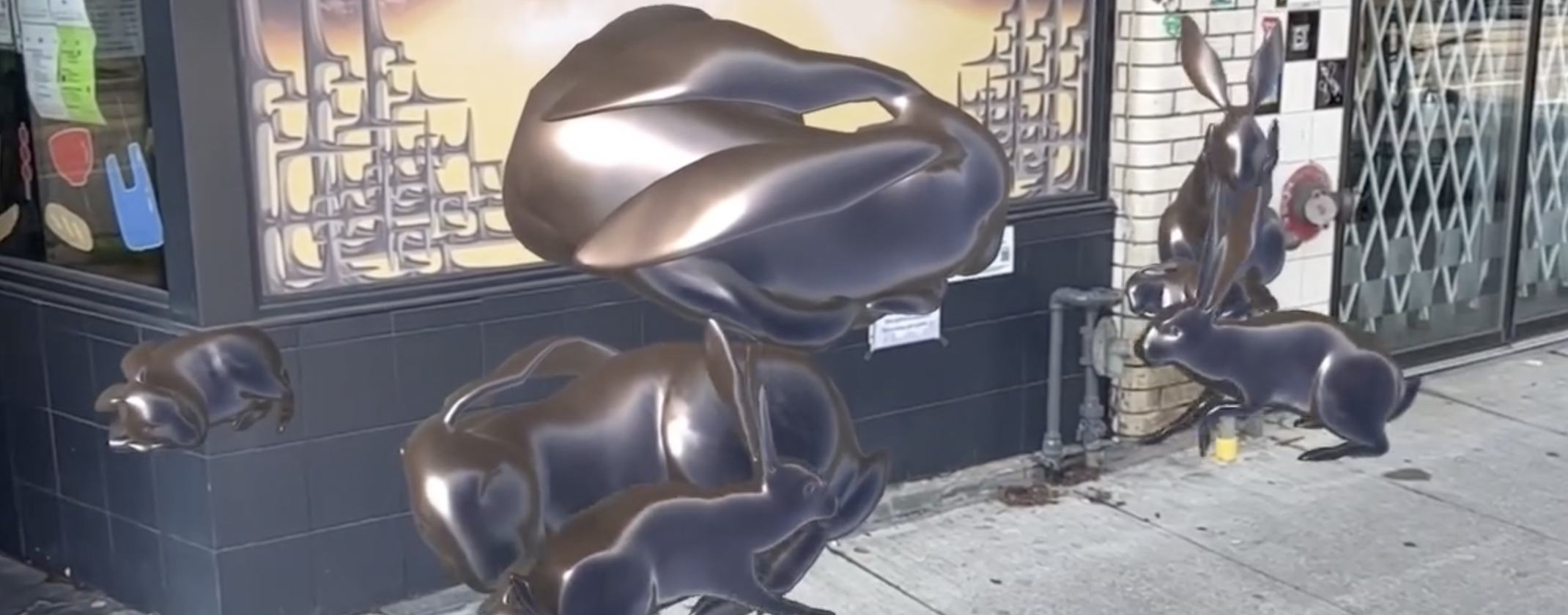
Call for Applications: AR Residency & Multi-site Exhibition | VF26
We invite artists to propose AR artworks, rooted in sculptural, fabricated avatars, representing cyborgs that transition between digital and physical spaces.
Augmented (or extended) reality technologies allow us to see the digital within our IRL world, but often ignore the reality of our extended arm holding up the screen. We often bristle at the implications of treating our bodies like robots, or the trend towards biohacking ourselves into eternity. What if, conversely, we saw machines as if they were created in our own image? Can we imagine a world that invites the right-to-repair for human and machine bodies alike? Can we reframe the cyborg not as a metaphor, but as a reality of those living with synthetic interventions and computerized body parts (PICC lines, insulin pumps, prosthetic limbs), what Jillian Weise names the “common cyborg”?
Accepted artists-in-residence will create an augmented reality (AR) artwork—either newly developed or adapted from existing work—and fabricate a corresponding sculptural piece that serves as its physical counterpart. The residency includes a year-long membership to InterAccess’s studio, critique and thematic support throughout development from the curators, training presented by SariSari Xchange, and inclusion in a multi-site exhibition as part of Vector Festival 2026.
This residency is supported by the City of Toronto's Community Celebration Support Fund.
Timeline
Application deadline: March 30, 2026*
Artist notification: April 2026
Residency dates: May - July, 2026
Showcase dates: Within July 9 – 19, 2026
*Note: This deadline was extended from March 23.
Type of Submission
Artist applications to participate in a residency and exhibition featuring interconnected augmented reality (AR) and sculptural works.
Residency Format
The Vector Festival AR Residency is a three-month program culminating in a multi-site exhibition presented at partnering street-facing windows along Queen Street West. Participating artists will receive an InterAccess membership, which provides full access to the studio, including fabrication tools such as 3D printers, woodworking, sewing machines, and other fabrication equipment. The residency will include regular check-ins, skill-building workshops, and collaborative working sessions. Artists will receive an artist fee, as well as a dedicated budget to support fabrication costs.
Residency Output
Artists will complete two interconnected deliverables:
(1) an AR artwork
(2) a sculptural object that translates the digital work into a physical form
The pieces can be newly created or adapted from existing work. The AR component will be browser-based and accessible on smartphones, and will remain active throughout Vector Festival 2026.
Location
The residency will take place at InterAccess Gallery, located at 32 Lisgar Street, Toronto. The works will be exhibited in participating locations along Queen Street West in downtown Toronto.
Fees
Vector Festival does not charge submission fees. All artists selected for participation will receive fees in accordance with CARFAC and IMAA fee schedules, as well as support to apply for external funding.
Equity
InterAccess is committed to equity and strongly encourages applications from equity-deserving communities, including artists who are Black, Indigenous, People of Colour, LGBTQ-identified, Gender Diverse, Two-Spirit, and Persons with Disabilities.
Collaborators
This program is jointly curated by Christina Dovolis and Evangeline Y Brooks. The residency is co-presented by InterAccess Gallery and Sari-Sari Xchange, with additional support from the City of Toronto Community Celebration Support Fund.
Contact
Please reach out to art@interaccess.org with any questions.
Header image of Lauren Warrington's work in A phosphene rifts, curated by Philip Leonard Ocampo and Sameen Mahboubi for Vector Festival 2024.
VF26: AR Residency Submission Form
Applications cannot be edited after submitting.