
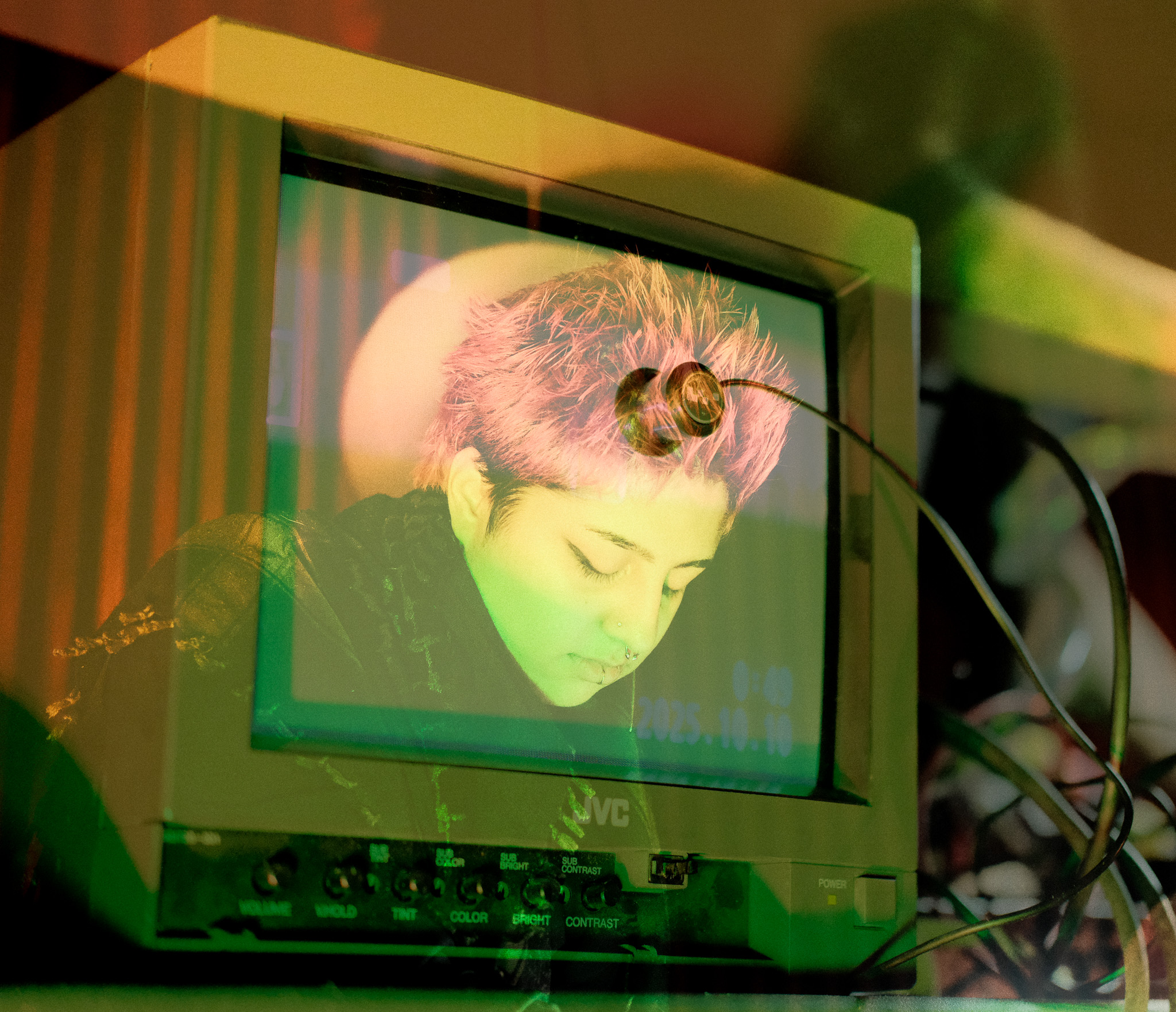
Centring Static: The Resistance of Auditory Friction
Saturday, February 7, 2025 | 2:30 – 4PM
Register here
What is felt, even when it is not heard? When a voice on magnetic tape is eroded, it makes a sound. Even when the words are sanded down, the voice of it still remains – there is a crackling static that it leaves behind. Erasure is not silent; it can be loud, amplified, and it has the power to get under the skin.
Using static as a tool of resistance, multidisciplinary artist, instrument designer, and 2025 Media Arts Prize Finalist, Aliyah Aziz audibly extends the hidden sonic textures that exist underneath the perceived smoothness of our machines, weaving them into a narrative tapestry to tell stories that lean into the sensations that exist beyond language as vehicles of movement for the eroded voice.
This artist talk will discuss the process and theory behind Aziz's thesis project, Sandpaper Hammock, a performance series consisting of custom-built instruments that allow her to amplify electromagnetic frequencies from a variety of technological artifacts, including video signals from a CRT monitor, cassette tapes, radio static, and other sounds that extend beyond their physical forms.
After a live performance by the artist, participants will have the opportunity to play with “Listening Gloves”, wearable instruments Aziz designed to sense EMF through touch.
Attendees are invited to bring a technological artifact of their own to listen to with the instrument, gathering in honour of feeling the statics humming beneath our fingertips, even when we aren’t listening.
About the Artist
Aliyah Aziz is a multidisciplinary storyteller, poet and musician who uses light to talk about shadows, and sound to physically move them through us. She uses disruption as a tool of resistance, embracing glitch and static to channel the friction that exists between the surface and the depth of the technology that we engage with. Aziz’s expressions take many forms, from multimedia moving collages of archived material, experimental sound and poetry compositions, interactive media installations, to performance art. She considers her practice to be an exploration of identity and the power that stories hold, from the history of our shadows to the projection of our futures.
Aziz works with experimental sound techniques and audio archives such as voice loop samples on magnetic tape, as well as electromagnetic frequency statics made audible in combination with spoken word recitations. She is currently exploring live performance in 5.1 using different instruments she has built to direct the power of the “auditory glitch” as a liberating disruption in confronting naturalized instances of dehumanization of the “other”. Aziz finds that cultural resilience is only possible through resistance, and her work is how she does this, using sound as a material force.
About the Media Arts Prize
Since 1990, the InterAccess Media Arts Prize has been granted annually to a graduating student whose work exhibits excellence and innovation in new media practice. Nominations are adjudicated by InterAccess's Programming Committee, who select a prize winner to be awarded a solo exhibition opportunity, a complimentary one-year studio membership, and professional development and mentorship. Finalists receive a complimentary one-year studio membership to InterAccess and an opportunity for a public artist program.
Image courtesy of Ziv Katz.